
• Cgeldert@shaw.ca
(403) 620-8534
Christopher Geldert, CA
  • HOME
  • ABOUT
    • ABOUT
    • SUPPLIERS
    • RESOURCES
    • PRIVACY & TERMS
  • SERVICES
    • INSURANCE PLANNING
      • LIFE INSURANCE
      • MORTGAGE LIFE INSURANCE
      • DISABILITY INSURANCE
      • CRITICAL ILLNESS INSURANCE
      • HEALTH & DENTAL
    • FAMILIES
      • ESTATE PLANNING
      • ESTATE PLANNING FOR MATURE FAMILIES & RETIREES
      • INSURANCE PLANNING
    • BUSINESS OWNERS
      • INSURANCE PLANNING
      • ESTATE PLANNING
  • CONTACT
  • LATEST NEWS
  • Click to open the search input field Click to open the search input field Search
  • Menu Menu

First Home Savings Account (FHSA): What You Need to Know

Blog, Investment

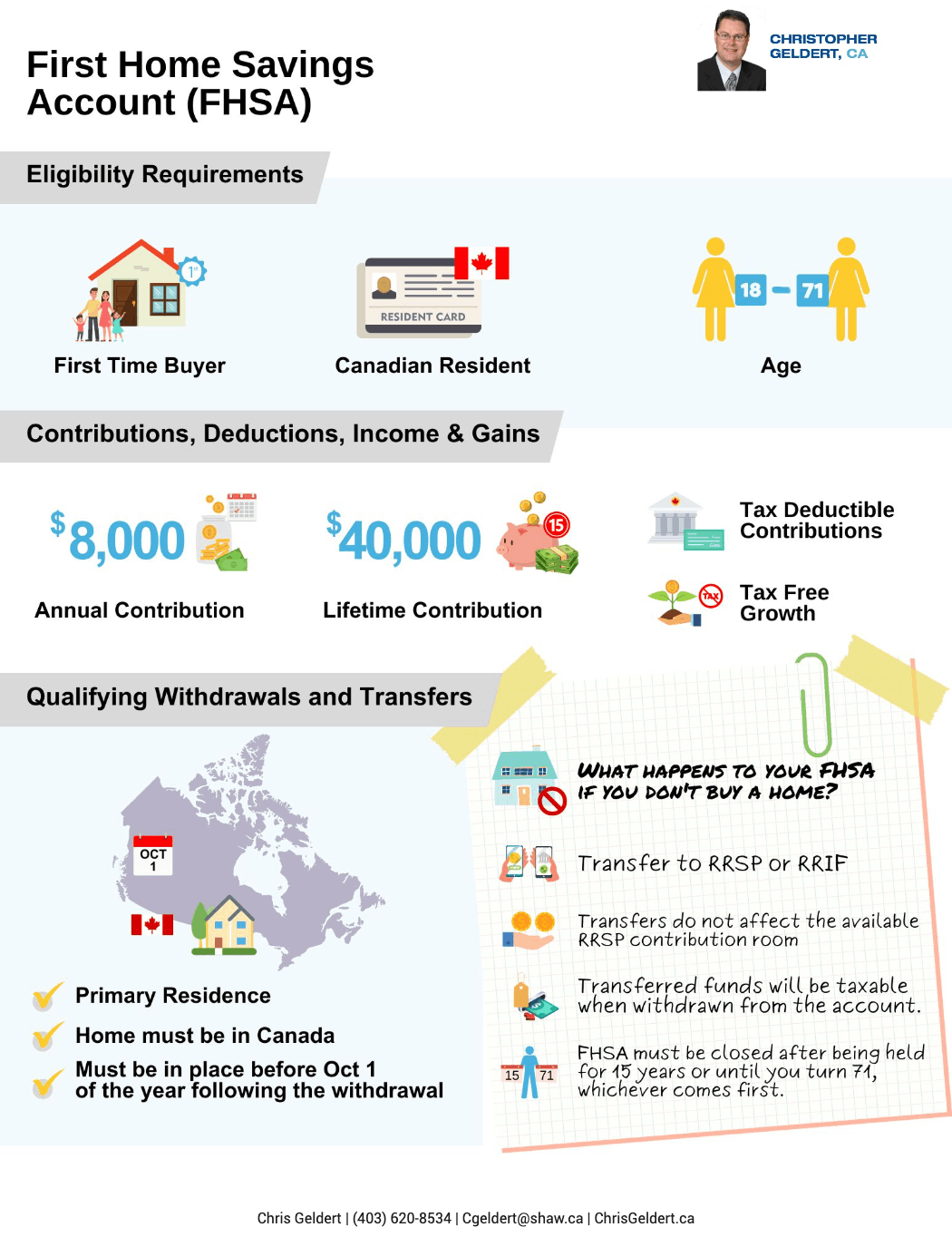
The First Home Savings Account (FHSA) is a savings plan designed for first-time home buyers in Canada, which allows them to save up to $40,000 tax-free. Contributions to an FHSA are tax-deductible, similar to Registered Retirement Savings Plans (RRSP). Additionally, income and gains earned inside the account and withdrawals are tax-free, like a Tax-Free Savings Account (TFSA).

In this article and accompanying infographic, we will provide you with the necessary information you need to know about FHSA, including eligibility requirements, contributions and deductions, income and gains, qualifying investments, withdrawals, and transfers.

Eligibility Requirements

To be able to open an FHSA, you need to meet all the following eligibility requirements:

  1. Residency: You must be an individual who is a resident of Canada.

  2. Age: You must be at least 18 and not reach 72 in the current year.

  3. First-time Home Buyer: You must be a first-time home buyer, which means that neither you nor your spouse had owned a qualifying home that was your principal residence at any point during the calendar year or the preceding four calendar years before the account was opened.

Contributions and Deductions

There are limits to the amount you can contribute to your FHSA.

  • The annual contribution limit is $8,000.

  • The lifetime contribution limit is $40,000.

If you do not contribute the full amount each year, the contribution room carries forward to the following year. However, carry-forward amounts only start accumulating after you open an FHSA for the first time, and they do not automatically begin when you turn 18.

Any excess contributions are subject to a penalty of 1% per month.
brandableContent

Tax Deductions

By claiming contributions made to FHSA accounts as a deduction against all taxable income sources, the amount of taxable income for the year can be reduced, resulting in a decrease in the amount of taxes payable.

Suppose you choose not to claim the FHSA deduction in the year. In that case, you can carry forward the unused contribution amounts indefinitely and claim them as a deduction later, like RRSP deductions.

Qualifying Investments

Qualifying investments for an FHSA are like those allowed in RRSPs and TFSAs, including mutual funds, segregated funds, ETFs, stocks, bonds, and GICs.

Incomes and Gains

The income and capital gains earned in an FHSA are not included in your annual income for tax purposes and therefore are not deductible. This means that the investment can continue to grow and compound within the FHSA tax-free like a TFSA.

Qualifying Withdrawals

Withdrawals from an FHSA are subject to specific rules and conditions. Qualifying withdrawals made to purchase a home are tax-free but must meet specific criteria:

  • The person making the withdrawal must be a first-time home buyer and a Canadian resident.

  • They must also intend to use the property as their primary residence within one year of purchasing or building it.

  • The home being purchased must be in Canada, and a written agreement to buy or build the home must be in place before October 1st of the year following the withdrawal.

It is not possible to restore FHSA contribution limits by making withdrawals or transfers.

Transfers

Unused funds in an FHSA account following a qualifying withdrawal can be transferred tax-free to an RRSP or Registered Retirement Income Fund (RRIF) until the end of the following year from the year of the first withdrawal. Transfers do not affect the available RRSP contribution room, but the transferred funds will be taxable when withdrawn from the account.

It’s important to remember that there are limitations on how long you can keep your FHSA account. You must close your FHSA after you’ve held it for 15 years or by the end of the year in which you turn 71, whichever comes first.

If you’re considering opening an FHSA or saving for a home, we can help; contact us.

by Chris Geldert
Share this entry
  • Share on Facebook
  • Share on X
  • Share on WhatsApp
  • Share on Pinterest
  • Share on LinkedIn
  • Share on Tumblr
  • Share on Vk
  • Share on Reddit
  • Share by Mail
https://chrisgeldert.ca/wp-content/uploads/2023/06/fhsaFI.png 250 500 Chris Geldert https://chrisgeldert.ca/wp-content/uploads/2020/05/christopherGeldertLogo5.png Chris Geldert2023-06-05 16:06:452023-06-05 16:07:00First Home Savings Account (FHSA): What You Need to Know

Pages

  • ABOUT
  • ADVANTAGE ACCOUNT
  • BLOG
  • BUSINESS CONTINUATION
  • BUSINESS SUCCESSION
  • CONTACT
  • CRITICAL ILLNESS INSURANCE
  • CRITICAL ILLNESS INSURANCE
  • DISABILITY INSURANCE
  • DISABILITY INSURANCE
  • EMPLOYEE BENEFITS
  • ESTATE PLANNING
  • Estate Planning for Business Owners
  • Estate Planning for Retirees and Mature Families
  • Estate Planning for Young Families
  • EXECUTIVE BENEFITS
  • Families
  • Farms
  • FINANCIAL ADVICE
  • FINANCIAL ADVICE FOR BUSINESS OWNERS
  • FINANCIAL ADVICE FOR BUSINESS OWNERS
  • FINANCIAL ADVICE FOR SENIORS
  • FLEXCARE, ASSOCIATION, HEALTH AND DENTAL PLANS
  • GROUP BENEFITS
  • GROWING FAMILIES
  • GUARANTEED INVESTMENT CERTIFICATES
  • HOME
  • How will rising interest rates impact Canadians?
  • INDIVIDUAL HEALTH AND DENTAL PLANS
  • Insurance Planning
  • Insurance Planning for Business Owners
  • Insurance Planning for Young Families
  • INVESTMENT PLANNING
  • LATEST NEWS
  • LIFE INSURANCE
  • Life Insurance
  • LIFE STAGES
  • MATURE FAMILIES
  • Mortgage Insurance
  • MORTGAGE LIFE INSURANCE
  • Non Registered Investments
  • Planning for Seniors
  • Preparing for Retirement
  • PRIVACY STATEMENT AND WEBSITE TERMS OF USE
  • REGISTERED DISABILITY SAVINGS PLAN
  • REGISTERED DISABILITY SAVINGS PLAN
  • REGISTERED EDUCATION SAVINGS PLAN
  • REGISTERED EDUCATION SAVINGS PLAN
  • REGISTERED RETIREMENT INCOME FUND
  • REGISTERED RETIREMENT INCOME FUND
  • REGISTERED RETIREMENT SAVINGS PLAN
  • REGISTERED RETIREMENT SAVINGS PLAN
  • Resources
  • RETIREES
  • RETIREMENT PLANNING
  • Retirement Planning for Business Owners
  • Retirement Planning for Employees
  • SERVICES
  • STARTING YOUR CAREER
  • STRATEGIC PARTNERSHIPS
  • SUPPLIERS
  • SUPPLIERS-old
  • TAX FREE SAVING ACCOUNT
  • TAX FREE SAVING ACCOUNT
  • THE NEED FOR CORPORATE LIFE INSURANCE
  • The Need for Corporate Life Insurance
  • THE NEED FOR PERSONAL LIFE INSURANCE
  • The Need for Personal Life Insurance

Categories

  • 2020
  • 2020 Only
  • 2021
  • 2022
  • 2022 Only
  • 2023
  • 2024
  • 2025
  • 2026
  • Accountants
  • Blog
  • Budget
  • Business Owners
  • Business Owners
  • Business Succession
  • Business Succession Planning
  • Buy Sell
  • Center of Influences
  • Charitable Gifting
  • Coronavirus
  • Coronavirus – Associates
  • Coronavirus – Practice Owners
  • Coronavirus – Retired
  • Coronavirus – Retiring
  • Coronavirus – Students
  • corporate
  • Critical Illness Insurance
  • Debt
  • dental benefits
  • disability
  • Disability Insurance
  • Estate Planning
  • Family
  • farmers
  • Finance
  • financial advice
  • Financial Planning
  • Government Budget
  • Group Benefits
  • health benefits
  • incorporated professionals
  • individuals
  • Insurance
  • Investment
  • Life Insurance
  • long term care
  • mortgage
  • Ontario Only
  • pension plan
  • personal finances
  • Professional Corporations
  • Professionals
  • RDSP
  • Registered Education Savings Plan
  • Retirees
  • Retirement
  • RRSP
  • RRSP
  • tax
  • Tax Free Savings Account
  • Travel Insurance

Archive

  • September 2026
  • August 2026
  • July 2026
  • June 2026
  • May 2026
  • April 2026
  • March 2026
  • February 2026
  • January 2026
  • December 2025
  • November 2025
  • October 2025
  • September 2025
  • August 2025
  • July 2025
  • June 2025
  • May 2025
  • April 2025
  • March 2025
  • February 2025
  • January 2025
  • December 2024
  • November 2024
  • October 2024
  • September 2024
  • August 2024
  • July 2024
  • June 2024
  • May 2024
  • April 2024
  • March 2024
  • February 2024
  • January 2024
  • December 2023
  • November 2023
  • October 2023
  • September 2023
  • August 2023
  • July 2023
  • June 2023
  • May 2023
  • April 2023
  • March 2023
  • February 2023
  • January 2023
  • December 2022
  • November 2022
  • October 2022
  • September 2022
  • August 2022
  • July 2022
  • June 2022
  • May 2022
  • April 2022
  • March 2022
  • February 2022
  • January 2022
  • December 2021
  • November 2021
  • October 2021
  • September 2021
  • August 2021
  • July 2021
  • June 2021
  • May 2021
  • April 2021
  • March 2021
  • February 2021
  • January 2021
  • December 2020
  • November 2020
  • October 2020
  • September 2020
  • August 2020
  • July 2020
  • June 2020
  • May 2020
  • April 2020

Chris Geldert CPA, CA, CLU, CEA

Navigating corporate structures and the insurance world can be difficult. I specialize in assisting business owners protect, realize and transfer the value of their business and corporate wealth. I guide owners through the process and work with their various professionals to ensure solutions implemented properly manage risks and maximize benefits. Above all, I work to earn your business.

Subscribe to my newsletter

* indicates required


Contact Me

Tel: (403) 620-8534

E: Cgeldert@shaw.ca

© 2020 Financial Tech Tools Inc. - Enfold WordPress Theme by Kriesi
Link to: The Case for Life Insurance Link to: The Case for Life Insurance The Case for Life Insurance Link to: Do you have enough for retirement? Link to: Do you have enough for retirement? Do you have enough for retirement?
Scroll to top Scroll to top Scroll to top